
To maximize muscle growth, the scientific evidence shows that doing 10 to 20 hard sets per muscle group per week produces optimal hypertrophy for natural lifters, while as few as 4 to 6 sets per week can maintain muscle mass and spark steady growth for beginners. Crucially, you've got to take these sets within 0 to 3 Reps in Reserve (RIR) and split them across at least two weekly sessions so you don't accumulate junk volume.
What if doing fewer sets in the gym actually makes your muscles grow faster?
For decades, bodybuilders were told that more sets always equal more gains. You've probably seen fitness influencers knocking out 25 sets for chest every Monday. They limp out of the gym. Then they brag about being sore for four straight days.
Here's the honest truth. Piling on endless sets creates deep fatigue without giving you extra muscle growth.
You don't need to spend two grueling hours in the weight room to build a strong physique. You just need enough tension to spark muscle growth, plus the patience to rest before fatigue ruins your progress. This guide breaks down new meta-regressions, maps your volume landmarks, and shows you how to dial in your weekly sets.
Key Takeaways (TL;DR)
- The Hypertrophy Sweet Spot: Doing 10 to 20 hard sets per muscle group per week maximizes muscle growth for more than 85% of natural lifters.
- The Minimum Effective Dose: As few as 4 to 6 high-intensity sets (0–1 RIR) per week maintains muscle mass or yields measurable gains during busy schedules.
- The Single-Session Ceiling: Performing more than 6 to 8 hard sets for a single muscle group in one workout triggers steep diminishing returns and generates junk volume.
- The 0.5 Fractional Counting Rule: Heavy compound exercises count as 1.0 set for prime movers and 0.5 sets for secondary synergists (such as triceps in a bench press).
- Static Volume Beats Set Chasing: Keeping your weekly sets stable and driving progress through heavier weights and extra reps beats adding endless sets each week.
When Alex, a 29-year-old accountant from Chicago, hit a training plateau in 2025, he was doing 24 sets of chest every Monday. His bench press had been stuck at 92.5 kg (205 lbs) for 14 months. His shoulders constantly ached.
Alex decided to cut his chest volume in half. He dropped to 10 hard sets per week, doing 5 sets on Monday and 5 sets on Thursday.
Within eight weeks, his bench press jumped to 105 kg (231 lbs). His joint ache vanished completely. Best of all, his chest showed thick new growth.
---
The Scientific Evidence: What Modern Meta-Regressions Reveal About Volume

For years, the fitness industry relied on small studies to debate volume. Some coaches claimed 3 sets were plenty. Others insisted you couldn't grow without 30 sets.
Recent landmark research has settled this debate with clear data.
The Dose-Response Curve and Diminishing Returns
The most thorough volume meta-regression to date, published in *Sports Medicine* by Pelland et al., covering 67 studies and 2,058 participants, examined the link between weekly sets and muscle size.
The researchers discovered a 100% posterior probability of a positive dose-response relationship between weekly set volume and hypertrophy. More hard sets do lead to more muscle growth.
However, that growth curve isn't flat. It flattens out quickly as fatigue sets in.
Your first set delivers the biggest single stimulus of the day. Each extra set gives you slightly less growth, but it adds equal or greater fatigue.
Once you reach 10 to 14 sets per week, you've locked down roughly 80% to 85% of your total growth potential. Pushing from 15 sets to 22 sets takes huge energy reserves for just a tiny 5% boost in size. That's why smart lifters don't waste their energy chasing endless sets.
| Weekly Set Bracket | Hypertrophy Stimulus | Fatigue & Joint Wear | Best Suited For |
|---|---|---|---|
| 1 to 5 sets/week | Low to Moderate (~60%) | Very Low | Maintenance, busy lifters, beginners |
| 6 to 10 sets/week | Moderate to High (~80%) | Low to Moderate | Beginners, early intermediates, high-stress jobs |
| 10 to 16 sets/week | Optimal (~90–95%) | Manageable | Most natural intermediates and advanced lifters |
| 16 to 22 sets/week | Peak Potential (~98%) | High | Advanced lifters with great sleep, diet, and low stress |
| 23+ sets/week | Diminishing (<100%) | Extreme (Burnout risk) | Genetic outliers, specialized lagging muscle focus |
Does Training Frequency Matter Independently?
Pelland et al. also analyzed whether training a muscle 1, 2, or 3 times per week makes a difference when total weekly sets match.
The data revealed that frequency has a negligible independent effect on muscle growth when weekly volume is equated. Hitting a muscle once a week with 10 sets produces similar total growth to hitting it twice a week with 5 sets, as long as you push those sets hard.
Still, frequency matters because it lets you distribute your volume cleanly. If you need 14 weekly sets to maximize growth, doing all 14 sets in one day ruins your late-set performance. Spreading those sets across two or three workouts keeps every rep crisp and productive.
If you'd like to structure your week around high-frequency training, check out our complete breakdown on full body workout 3 days a week. It's a proven routine that's built for rapid recovery.
---
What Actually Qualifies as a "Hard Set"?
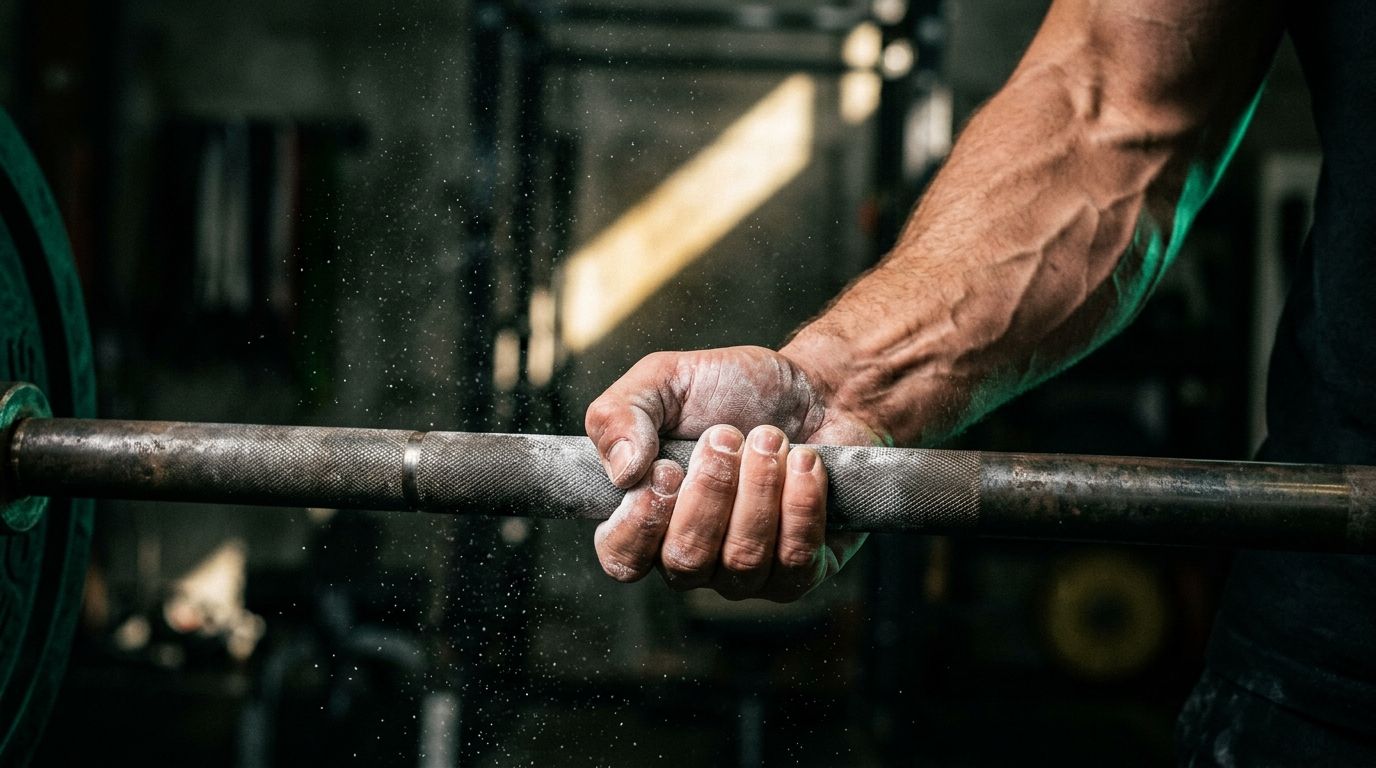
Before counting weekly sets, you must define what counts as a real working set.
Counting sets without checking intensity is like tracking calories without checking portion sizes. If you do 15 easy sets with light dumbbells while scrolling on your phone, you haven't built any muscle. You're just breaking a sweat.
The Proximity to Failure Standard (RIR and RPE)
To spark muscle growth, a set must challenge your muscle fibers near failure.
Sports scientists measure intensity using Reps in Reserve (RIR) or the Rating of Perceived Exertion (RPE) scale:
- 0 RIR (RPE 10): Absolute muscular failure. You couldn't finish another rep with good form if your life depended on it.
- 1 RIR (RPE 9): One rep shy of failure. You could grind out exactly one more clean rep.
- 2 RIR (RPE 8): Two reps shy of failure. The bar slowed down, but you had two solid reps left.
- 3 RIR (RPE 7): Three reps shy of failure. The set felt tough, but you stopped three reps early.
- 4+ RIR (RPE 6 or lower): Warm-up or low-stimulus work. These sets don't count toward your weekly hypertrophy volume.
Only sets done at 0 to 3 RIR stimulate enough mechanical tension to qualify as working sets. Warm-up sets and easy pump sets don't spark muscle growth. They're just warm-up work.
The Subconscious Sandbagging Trap
When lifters plan massive 25-set workouts, their minds play tricks on them.
If you know you have to survive six chest exercises totaling 20 sets, you won't push your early sets hard. You'll leave 4 or 5 reps in reserve to save energy for later. That's human nature.
Those early sets turn into useless warm-ups. Meanwhile, your later sets suffer from heavy central fatigue. You leave the gym sweating, but you haven't stimulated new muscle fibers.
When you limit yourself to 5 or 6 hard sets per workout, you can push every rep with full focus. You'll stimulate more muscle fibers in half the time.
---
The Four Volume Landmarks: MV, MEV, MAV, and MRV Explained
To customize your weekly volume, exercise scientist Dr. Mike Israetel created Volume Landmarks. These landmarks show how many sets per muscle per week you need based on your experience and recovery.
| Volume Landmark | Typical Range | Primary Objective & Physiological Effect |
|---|---|---|
| Maintenance Volume (MV) | 4 to 6 sets/week | Keeps current muscle tissue intact during busy periods, travel, or fat loss. |
| Minimum Effective Volume (MEV) | 6 to 10 sets/week | The lowest weekly dose that ignites consistent, measurable muscle hypertrophy. |
| Maximum Adaptive Volume (MAV) | 10 to 18 sets/week | The optimal sweet spot where you build muscle at the quickest sustainable rate. |
| Maximum Recoverable Volume (MRV) | 20 to 25+ sets/week | The biological ceiling where cumulative fatigue overpowers your recovery capacity. |
1. Maintenance Volume (MV): 4 to 6 Sets Per Week
Maintenance Volume is the smallest number of hard sets needed to keep your existing muscle.
Preserving muscle is much easier than building new tissue. If you're traveling, handling high stress, or nursing a sore joint, doing 4 to 6 hard sets (0–1 RIR) per week will protect your gains for months. You won't lose size as long as your effort stays high.
Sarah, a 36-year-old biomedical engineer and mother of two, faced a four-month project deadline with 60-hour workweeks. She didn't want to abandon her fitness goals. So, she stripped her leg training down to Maintenance Volume.
Sarah did 3 sets of squats on Tuesday and 3 sets of Romanian deadlifts on Friday, pushing each set to 1 RIR. She finished each workout in 40 minutes flat.
After four months, her body scan showed zero lost leg muscle. She'd even added 1.2 cm of quad sweep because her high intensity kept her muscle fibers fully stimulated. That's the power of training with intent.
2. Minimum Effective Volume (MEV): 6 to 10 Sets Per Week
Minimum Effective Volume is the lowest volume that sparks noticeable, steady muscle growth.
For beginners, MEV is very low, often just 4 to 6 sets per week. For intermediates, MEV is usually 6 to 10 sets. If you want steady gains while spending under 45 minutes in the gym, training at your MEV is your best bet. It's efficient, sustainable, and leaves plenty of energy for your daily life.
3. Maximum Adaptive Volume (MAV): 10 to 18 Sets Per Week
Maximum Adaptive Volume is the hypertrophy sweet spot. This is where natural lifters build muscle at the fastest possible rate without burning out.
For most lifters, MAV sits between 10 and 16 sets per muscle per week. In this zone, your muscles get plenty of tension to grow, while your joints and nerves have time to recover. It's the gold standard for long-term bodybuilding progress.
4. Maximum Recoverable Volume (MRV): 20 to 25+ Sets Per Week
Maximum Recoverable Volume is your body's recovery ceiling. It's the most volume you can handle before progress stalls.
If you train past your MRV, you enter non-functional overreaching. Your joints hurt, your sleep suffers, and your gym numbers drop week after week. That's a clear red flag.
Your MRV isn't set in stone. It changes based on your sleep, food intake, and stress levels. When you're cutting calories to lose fat, your MRV drops significantly because you don't have extra fuel to repair tissue.
---
The Per-Session Volume Ceiling: Stop Wasting Time on Junk Volume
Knowing your weekly set target is only half the battle. How you split those sets across the week determines whether you build muscle or just waste energy.
The 6 to 8 Set Intra-Workout Ceiling
Can you do all 16 of your weekly chest sets on Monday afternoon?
You can try. But science shows it's a terrible way to train.
Studies tracking muscle protein synthesis show that doing more than 6 to 8 hard sets for one muscle in a single workout yields sharp diminishing returns. Sets 9, 10, 11, and 12 produce almost no extra growth while creating huge muscle damage and joint strain.
If your routine calls for 14 weekly sets of back work, doing 7 sets on Monday and 7 sets on Thursday will build far more back width than grinding through 14 sets in one long workout. You'll lift heavier weights on every set and keep your form pristine.
Video Breakdown: The Truth About Junk Volume
For a clear visual breakdown of junk volume, check out this guide from Dr. Mike Israetel and natural bodybuilder Jeff Nippard:
*Video summary: Dr. Mike Israetel and Jeff Nippard show why splitting sets across 2 to 3 sessions prevents junk volume and boosts overall mechanical tension.*
---
Direct vs. Indirect Volume: The 0.5 Fractional Counting Rule
One of the easiest ways to mess up your volume tracking is ignoring compound overlap.
When you do four heavy sets of bench press, your chest does most of the work. But your shoulders and triceps work hard too. If you ignore that work and add 16 sets of tricep extensions later in the week, your elbows will hurt.
On the other hand, if you count bench press as four full tricep sets, you won't train your arms enough. The long head of the tricep gets very little stimulus during bench pressing. That's why you need a balanced formula.
The Fractional Volume Solution
In their meta-regression, Pelland et al. tested three ways to count secondary muscle work:
- Total Model: Counting compound work as a full set (1.0).
- Direct-Only Model: Ignoring compound synergist work (0.0).
- Fractional Model: Counting compound work as half a set (0.5).
The evidence strongly supported the Fractional Model (0.5x).
Counting compound synergists as 0.5 sets gives you an accurate estimate of real fatigue and muscle stimulus. It's the most reliable way to avoid overtraining.
| Exercise Movement | Primary Muscle (Counts as 1.0 Set) | Secondary Muscle (Counts as 0.5 Set) | Negligible / 0 Set |
|---|---|---|---|
| Barbell Bench Press | Pectorals (Chest) | Anterior Delts, Triceps (Medial/Lateral) | Biceps, Lats |
| Incline Dumbbell Press | Clavicular Head (Upper Chest) | Anterior Delts, Triceps | Lower Lats |
| Overhead Barbell Press | Anterior Delts, Medial Delts | Triceps, Upper Traps | Chest, Lats |
| Barbell Bent-Over Row | Latissimus Dorsi, Rhomboids | Biceps (Brachialis), Posterior Delts | Pectorals, Quads |
| Neutral-Grip Lat Pulldown | Lats, Teres Major | Biceps, Brachioradialis | Triceps, Abs |
| Barbell Back Squat | Quadriceps | Gluteus Maximus, Adductor Magnus | Hamstrings |
| Romanian Deadlift (RDL) | Hamstrings, Gluteus Maximus | Erector Spinae, Adductors | Quadriceps |
| Dumbbell Bicep Curl | Biceps Brachii | Brachialis, Forearms | Triceps, Shoulders |
| Tricep Rope Pushdown | Triceps Brachii (All 3 Heads) | Forearms (Anconeus) | Biceps, Chest |
Practical Example: Calculating Tricep Volume
Let's look at a lifter aiming for 12 total sets of triceps per week on an Upper/Lower routine:
- Upper Day 1: 4 sets Barbell Bench Press (4 × 0.5 = 2.0 tricep sets) + 3 sets Overhead Tricep Extensions (3.0 direct sets) = 5.0 sets
- Upper Day 2: 4 sets Incline Dumbbell Press (4 × 0.5 = 2.0 tricep sets) + 3 sets Overhead Press (3 × 0.5 = 1.5 tricep sets) + 3 sets Tricep Cable Pushdowns (3.0 direct sets) = 6.5 sets
- Total Weekly Tricep Volume: 5.0 + 6.5 = 11.5 working sets
By using the 0.5 rule, this lifter hits their tricep goal with only 6 direct isolation sets. Their elbows stay pain-free, workouts finish on time, and their arms grow steadily. You'll make faster progress when your joints feel good.
If you train at home with limited equipment, see our dumbbell only workout plan to apply fractional volume with free weights.
---
The Muscle-by-Muscle Weekly Volume Guide
Different muscles have unique fibers, stretch capacities, and recovery rates.
Big muscles that stretch under heavy loads (like quads and hamstrings) generate huge fatigue and muscle damage. They need more recovery time and thrive on moderate volume.
In contrast, smaller muscles that don't experience deep stretch under load (like side delts, rear delts, and calves) recover fast. They can handle, and often need, higher weekly set counts. They won't grow unless you give them frequent attention.
The table below gives you clear weekly set ranges for each major muscle group:
| Muscle Group | Maintenance (MV) | Optimal Sweet Spot (MAV) | Maximum Recoverable (MRV) | Recommended Frequency |
|---|---|---|---|---|
| Chest | 4 sets/week | 10 to 16 sets/week | 20 sets/week | 2x per week |
| Back (Lats & Mid-Back) | 6 sets/week | 12 to 18 sets/week | 22 sets/week | 2 to 3x per week |
| Quadriceps | 4 sets/week | 10 to 14 sets/week | 18 sets/week | 2x per week |
| Hamstrings | 4 sets/week | 8 to 12 sets/week | 16 sets/week | 2x per week |
| Glutes | 3 sets/week | 8 to 14 sets/week | 18 sets/week | 2x per week |
| Side (Lateral) Delts | 6 sets/week | 14 to 22 sets/week | 26 sets/week | 2 to 4x per week |
| Rear Delts | 4 sets/week | 10 to 16 sets/week | 20 sets/week | 2 to 3x per week |
| Biceps (Direct) | 3 sets/week | 6 to 12 sets/week | 16 sets/week | 2 to 3x per week |
| Triceps (Direct) | 3 sets/week | 6 to 12 sets/week | 16 sets/week | 2x per week |
| Calves | 4 sets/week | 10 to 16 sets/week | 20 sets/week | 2 to 4x per week |
| Abdominals | 0 to 3 sets/week | 6 to 12 sets/week | 16 sets/week | 2 to 3x per week |
*Note: Arm volume numbers represent direct isolation work assuming you also perform compound pressing and rowing.*
---
Volume Demands by Training Experience
Your training age dictates how many sets you need to spark fresh muscle growth.
1. Beginners: The Rapid-Response Stage (6 to 10 Sets Per Week)
When you first begin resistance training, your neuromuscular system is remarkably responsive to mechanical tension. A novice lifter can trigger robust muscle protein synthesis and rapid hypertrophy with as few as two or three challenging sets of squats or bench presses per workout.
At this stage, more volume is actually counterproductive. Performing 15 or more weekly sets causes severe delayed-onset muscle soreness (DOMS) and joint inflammation that derail your training consistency without accelerating gains. Your primary objective during year one is mastering pristine lifting technique and driving linear progression, adding weight or clean repetitions to the bar every single week.
2. Intermediates: The Progressive Overload Sweet Spot (10 to 16 Sets Per Week)
After 12 to 18 months of consistent lifting, the initial rapid adaptations taper off. Your muscles adapt to mechanical load, requiring a higher volume stimulus to spark further growth. Most natural lifters thrive on 10 to 16 sets per muscle per week, ideally split across two weekly workouts.
Rather than jumping straight to 20 sets, intermediates succeed by mastering double progression: select a working rep range (such as 8 to 12 reps), hit the top of the range on all sets with impeccable form, and only then increase the weight on the bar while keeping weekly volume steady.
3. Advanced Lifters: Strategic Specialization (14 to 20+ Sets Per Week)
Lifters with four or more years of dedicated training are inching close to their genetic ceiling. At this stage, muscle tissue requires either higher proximity to failure (0 to 1 RIR) or elevated set volumes (16 to 22 sets weekly) to trigger an adaptive response.
However, attempting to train every muscle group with 20 sets simultaneously creates an unmanageable recovery deficit. Advanced lifters avoid burnout by utilizing Volume Specialization Blocks: prioritize one or two lagging muscle groups with high volume (18 to 22 sets weekly) while dropping well-developed muscle groups down to Maintenance Volume (4 to 6 sets weekly) to preserve systemic recovery.
---
How to Distribute Your Sets: Sample Workout Splits
To keep your set quality high, you should pair your weekly sets with a smart workout split. Here is how three proven training splits distribute volume while respecting the 6 to 8 set single-session ceiling:
Option 1: The 3-Day Full-Body Routine (Ideal for Busy Schedules)
- Weekly Schedule: Monday, Wednesday, Friday (with 48 hours of recovery between sessions).
- Volume Distribution: 3 to 5 hard sets per muscle group per workout (accumulating 9 to 15 weekly sets).
This setup allows you to train every major muscle group three times per week with modest per-session fatigue. Because you perform only 3 or 4 sets per muscle in any single workout, your motor unit recruitment and bar speed remain exceptionally high from the first repetition to the last.
Option 2: The 4-Day Upper / Lower Split (The Natural Bodybuilding Standard)
- Weekly Schedule: Monday (Upper), Tuesday (Lower), Thursday (Upper), Friday (Lower).
- Volume Distribution: 5 to 7 hard sets per muscle group per workout (accumulating 10 to 14 weekly sets).
The Upper / Lower split is widely regarded as the gold standard for natural lifters. It hits each muscle group twice weekly, easily stays below the 6-to-8-set per-session threshold, and provides a full 72 hours of recovery between corresponding muscle sessions.
Option 3: The 5-Day Push / Pull / Legs + Upper / Lower Hybrid
- Weekly Schedule: Monday (Push), Tuesday (Pull), Wednesday (Legs), Friday (Upper), Saturday (Lower).
- Volume Distribution: 4 to 6 hard sets per muscle group per workout (accumulating 12 to 18 weekly sets).
For lifters who thrive on higher frequency and enjoy shorter, focused gym sessions, this hybrid split distributes volume across five days. Each workout takes under 50 minutes while keeping cumulative fatigue low and session quality at an absolute peak.
---
How to Tell If You Are Doing Too Many (or Too Few) Sets
Your body gives clear warning signs when your weekly volume is off track. Use this diagnostic checklist to fine-tune your training:
### Signs You're Doing Too Many Sets (Exceeding MRV)
1. Declining Strength: You can't hit your target reps with weights you lifted easily two weeks ago.
2. Joint and Tendon Ache: Your elbows, knees, or shoulders ache, especially during warm-ups.
3. Disrupted Sleep: You wake up often during the night or feel wired when trying to sleep.
4. Lingering Soreness: Muscles stay sore for more than four days after a session.
5. Dreading Workouts: You feel unmotivated and just want your workouts to end.
Marcus, a 31-year-old software developer, thought he needed 22 weekly sets of back training to build wide lats. Over six weeks, his elbows flared up with tendon pain.
His barbell row dropped from 84 kg (185 lbs) for 8 reps down to 75 kg (165 lbs) for 6 reps. He couldn't shake off the fatigue.
After reviewing this checklist, Marcus realized he was overtraining. He took a one-week deload, cut back volume to 12 sets per week, and eliminated redundant rows.
Within three weeks, his elbow ache was gone. His barbell row hit a lifetime best of 90 kg (198 lbs) for 8 clean reps. That's proof that less is often more.
### Signs You're Doing Too Few Sets (Below MEV)
1. Workouts Feel Easy: You leave the gym feeling just as fresh as when you arrived.
2. No Muscle Fullness: You never get a pump or feel any muscle fullness during or after training.
3. Zero Strength Progress Over 4+ Weeks: Your weights and reps haven't changed despite eating enough food and sleeping well.
The Fix: How to Run a Deload Week
If you show multiple signs of exceeding your MRV, don't try to grind through the fatigue. Take a planned Deload Week:
- Cut Sets in Half: If you normally do 14 sets, perform exactly 7 sets.
- Keep Weights Heavy: Use your normal working weights to keep your strength adaptations sharp.
- Stay 3 Reps from Failure: Stop each set at 3 RIR so your connective tissues can heal.
---
Frequently Asked Questions (FAQ)
Q:Do warm-up sets count toward my weekly set volume?
Q:Is 10 sets per week enough to build serious muscle?
Q:Can I do all my weekly sets for a muscle in one workout?
Q:How many direct sets should I do for arms each week?
Q:Why do enhanced bodybuilders do 25 to 30 sets while natural lifters do less?
---
Build Your Evidence-Based Volume Plan Today
Muscle growth doesn't reward endless exhaustion; it rewards progressive tension.
When you stop judging a workout by how tired you feel and start judging it by progressive overload and clean execution, building muscle becomes predictable.
You don't need to spend two hours exhausting yourself with 25 sets every day. Pick a target between 10 and 16 hard sets per muscle per week. Split those sets across two or three weekly workouts so you never exceed 6 to 8 sets per muscle in a single session. Take each set to an honest 1 to 2 Reps in Reserve, track your numbers, and give your body the food and rest it needs to grow.
Your 3-Step Action Plan for This Week:
- Audit Your Current Volume: Count your working sets for every muscle group using the 0.5 fractional rule for compound synergists.
- Cap Your Sessions: If any workout includes more than 8 sets for one muscle group, split those sets into a second training day.
- Lock In Your Numbers: Keep your set count constant for the next six weeks. Put 100% of your energy into adding weight to the bar and squeezing out extra clean reps.
---